
Due Diligence: What Investors Check and When It Gets Serious
Due diligence for founders: what it means, how seed and Series A diligence differ, the 7 document categories YC lists, and the checks that catch fraud.
Updated 14 min read


Due diligence for founders: what it means, how seed and Series A diligence differ, the 7 document categories YC lists, and the checks that catch fraud.
Due diligence is the investigation a buyer or investor runs before committing money, to confirm that what they were told is true. Cornell's Legal Information Institute ties it to the reasonable care expected to avoid liability, which commonly means reviewing financial records before a securities offering or an acquisition. For founders, it is the document and data check that sits between a yes and the wire.
How much of it you face depends on the deal. Y Combinator tells seed founders to avoid investors who ask for too much diligence. Its Series A checklist runs to seven document categories and warns that closing can take more than a month.
This guide covers what due diligence means and how its scope changes from a seed round to a priced round or an acquisition. It also lists what investors request and the verification checks behind two well-known startup fraud cases.
In plain words, due diligence means checking before you commit. A person who "does their due diligence" has looked into something carefully enough that nobody could say they were careless.
The legal meaning is narrower. Cornell's Wex dictionary describes it as "the level of reasonable care or attention expected to avoid liability, especially in legal and financial matters."
The term carries real weight in US securities law. Under Section 11 of the Securities Act, underwriters, directors, officers, and experts can use a due diligence defense if they investigated a registration statement properly. The issuer itself is strictly liable and cannot.
In startup fundraising, light diligence can start after a good first meeting, when an investor asks for your data room, as a16z describes it. The full legal review follows the term sheet.
Investors compare the deck with the financial model, the cap table with the signed stock documents, and the traction slide with customer data. The goal is to find surprises before signing, while there is still time to price them in or walk away.
A founder on r/startups described investor questions about moats and how easily the product could be copied as tech due diligence. A reply in the same Reddit thread argued that real diligence begins only once there is a deal in principle.
The same word covers several different reviews. Most deals mix more than one.
Type | What gets checked | When founders meet it |
|---|---|---|
Legal | Charter, bylaws, board and stockholder consents, contracts, litigation | Priced rounds, acquisitions |
Financial | Financial statements, P&L and burn, projections, debt | Once there is revenue; every priced round |
Securities and cap table | Who owns what, option grants, vesting, convertible instruments | Every priced round |
Intellectual property | Patents, trademarks, domains, invention assignment agreements | Priced rounds, acquisitions |
Commercial and product | Usage, retention, unit economics, customer calls | Seed through growth rounds |
Team | Founder backgrounds, references, whether officers work full time | From the first check |
The legal and securities rows come straight from YC's checklist and the Cooley GO request list. The commercial row matches what a16z asks to see in a data room.
Being private and small does not lower the bar for honesty. The SEC charged Theranos in March 2018. Steven Peikin, co-director of its Enforcement Division, said there is no exemption from anti-fraud law "simply because a company is non-public, development-stage, or the subject of exuberant media attention."
The SEC repeated the point in April 2023 when it charged the founder of Frank: "Even non-public, early-stage companies must be truthful in their representations." Diligence is how investors and acquirers test that, and it is why a clean, consistent set of records is a fundraising asset in its own right.
The scope grows with the size and permanence of the deal. Closing on a safe means signing one document; a priced round produces definitive documents that YC's clean term sheet guide describes as "100+ pages" of binding contracts.
YC's seed fundraising guide is blunt: "Do not spend too much time developing diligence documents for a seed round. If an investor is asking for too much due diligence or financials, they are almost certainly someone to avoid." It recommends an executive summary and a deck you can leave behind.
The reason is the instrument. YC notes that closing on a safe is "as simple as signing a document and then transferring funds," so there is no long legal process for diligence to slot into.
What seed founders should still have ready: a clean cap table, signed founder stock and invention assignment documents, and a deck whose numbers match whatever spreadsheet sits behind it.
A priced round changes the process. After the term sheet, the investor's lawyers send a request list, and the YC checklist shows what it typically contains. YC says Jason Kwon, general counsel of YC Continuity, compiled it "after being involved in hundreds of financings with nearly every law firm and VC fund in the valley."
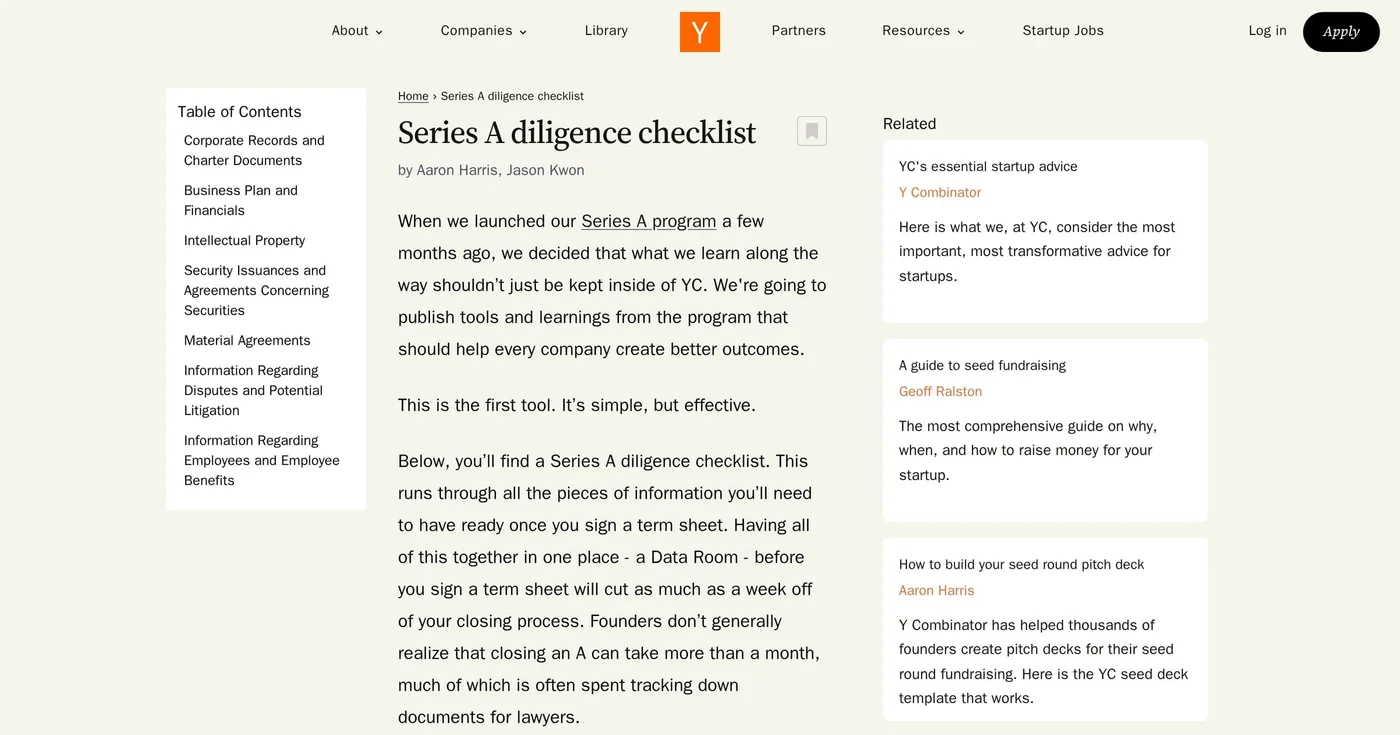
The timing catches founders out. YC says "closing an A can take more than a month, much of which is often spent tracking down documents for lawyers." Having everything in one data room before signing "will cut as much as a week off of your closing process."
Commercial diligence also deepens here. Investors want monthly history: a16z asks for historical P&L and burn, usage data covering growth, acquisition channels, engagement and retention, and LTV/CAC with payback period. If you quote efficiency benchmarks such as the Rule of 40 or burn rate, expect investors to recompute them from that P&L.
In an acquisition, the buyer is paying for the whole company, so it verifies the assets it is buying. The Frank case shows how far that verification goes and where it can break.
According to the Department of Justice, Frank's founder told two banks that the company had 4.25 million users. She defined a user as someone who had signed up and for whom Frank held a first name, last name, email address, and phone number. Frank had approximately 300,000.
A synthetic data set went to an agreed third-party vendor, which then told JPMorgan the file had over 4.25 million rows. JPMorgan bought Frank for $175 million.
The YC Series A checklist groups requests into seven categories. The Cooley GO list uses similar headings and adds a column to mark each item "Provided" or "Does Not Exist."
Category | Typical requests | What to check before sending |
|---|---|---|
Corporate records and charter | Board and stockholder minutes and consents, certificate of incorporation, bylaws, org chart for subsidiaries | A signed consent exists for every past stock issuance |
Business plan and financials | Current plan, projections, most recent financial statements | Every number matches the deck |
Intellectual property | Trademarks, patents, copyrights, domains, proof of assignment to the company | Every founder and contractor has assigned IP |
Securities | Stockholder and option holder lists with prices, vesting schedules, warrants, voting and transfer agreements, Rule 701 and blue sky compliance | Every promised grant is issued and documented |
Material agreements | Customer terms, agreements over $25,000, debt, leases, licenses, NDAs, consulting contracts, officers not working full time | Which contracts need consent to the financing |
Disputes and litigation | Pending or threatened claims, infringement allegations, labor disputes | Any claim tied to a founder's prior employment |
Employees and benefits | Staff list with salary and classification, offer letter form, severance and change-of-control terms, option plan forms, Form 5500 filings for 3 years if you sponsor a 401(k) | Contractor and employee classification, acceleration terms |
These records prove who owns the company.
YC asks for every stockholder with issuance date and original price, and every option holder with grant date and exercise price. It also wants "a summary of the vesting schedules of any stock or options subject to vesting, including any vesting acceleration." If you need a refresher on cliffs and schedules, see vesting schedules.
The founders' own paperwork belongs here too. A signed founders agreement and founder stock purchase documents answer the first questions a lawyer asks about the cap table.
Investors want proof that the company owns what it sells. YC asks for a list of trademarks, patents, copyrights, and domain names, and documentation of any assignment to the company.
Cooley's list goes a step further and asks for "a list of any employees or consultants who have not signed Proprietary Information and Invention Agreements." A gap in that list, especially for an early engineer or a founder who wrote code before incorporation, is worth closing before the round starts.
YC's material agreements section asks for any agreement involving obligations of, or payments to, the company over $25,000. It adds debt, leases, licenses, and "any agreements requiring consents or approvals in connection with the financing." A customer or lender contract that needs consent can hold up a close if nobody spots it early.
The litigation section covers pending or threatened actions, including those involving employees "in connection with their prior or present employment or use of technology."
Expect to share a list of employees and consultants with title, base salary, bonus or commission plan, exemption classification, and state of residence. YC also asks for any arrangement that pays out on a change of control and any severance or deferred compensation plans.
A data room is the shared folder that holds all of the above. The term is a holdover from the 1900s, a16z notes. Companies printed documents and put them in secure rooms for investors to review.
a16z's top five items are a pitch deck, a cap table, historical P&L and burn on a monthly basis, usage data, and LTV/CAC with payback period. For a priced round, add the YC legal categories above, organized under the same seven headings so the investor's lawyers can work through it without asking where things are.
The same a16z guide lists items it usually does not need up front. They are org charts and team bios, detailed three to five year projections, tax returns and audits, office leases and offer letters, board minutes, and market sizing. Sending everything at once slows the reader down and invites questions about documents nobody needed.
YC's checklist ends with a timing warning that rarely appears in diligence guides. Many people believe that once you have a term sheet you can no longer use your current 409A valuation for grants, because a material event has occurred. Employees still waiting for promised options would then get a higher strike price, which YC says can force you to raise their compensation to avoid a morale problem.
The fix is to issue pending grants before you start the round. You cannot control when a term sheet arrives, so a backlog of promised equity is a risk throughout the raise.
Investors split diligence into two jobs: reading what you provide, and confirming it against something you did not produce. The second job is where fraud gets caught or missed.
The Frank case turned on a definition. JPMorgan had been told what a "user" meant, yet the outside check reported only that the file had over 4.25 million rows, per the DOJ release. A row count confirms the size of a file, not whether each row is a real person who signed up.
The SEC complaint summary adds that when Frank's director of engineering refused to generate synthetic data, the founder allegedly paid a data science professor to do it. For founders on the other side of the table, the lesson is practical: define each headline metric in writing, the same way in the deck, the model, and the data room.
a16z's red flags are all reconciliation failures. Its list covers deck numbers that differ from the model ($2M ARR in the deck, $1.5M in the model), numbers that differ across tabs, short histories, and cherry-picked cohorts. Each one is cheap to fix before diligence and expensive to explain during it.
Theranos shows the scale a mismatch can reach. The SEC said the company claimed it would generate more than $100 million in revenue in 2014. It generated a little more than $100,000 from operations that year, and in total it raised more than $700 million from investors.
YC's estimate is that a ready data room saves up to a week of closing time. Starting after signing means your lawyers spend that week chasing board consents and old contracts while the deal sits open.
Unissued grants turn into a 409A problem once a term sheet lands, according to YC. Keep the option ledger current every month during a raise.
A founder or contractor who never signed an invention assignment leaves a hole in the company's IP. Cooley's request list asks for exactly that list of people, so assume the investor will find any gap.
"Users," "customers," and "ARR" drift between the deck and the model. Pick one written definition for each metric and use it everywhere. The Frank case shows what happens when a definition and the data behind it come apart.
Over-preparing at seed wastes time. YC's advice is a deck and a short summary, and to be wary of seed investors who ask for much more.
Frank was a student loan assistance company, as the SEC describes it. In 2021, two banks, one of them JPMorgan Chase, began acquisition processes, and JPMorgan agreed to buy the company for $175 million, according to the DOJ.
The diligence problem surfaced after closing. JPMorgan asked for Frank's user data to start a marketing campaign, and received data the founders had bought on the open market. The SEC said the founder received $9.7 million directly in stock proceeds and a contract for a $20 million retention bonus as a JPMorgan employee.
Charlie Javice and Olivier Amar were convicted of conspiracy, wire fraud, bank fraud, and securities fraud after a six-week jury trial in March 2025. On September 29, 2025, Javice was sentenced to 85 months in prison, with a forfeiture judgment of $22,360,977.48 and restitution of $287,501,078.00 joint and several with Amar.
For buyers, the takeaway is to verify a sample of records against the stated definition. For founders, it is simpler: the numbers in a data room become representations, and they follow you after the money arrives.
If you are lining up a round, our investors directory and the guide to startup funding stages show what each type of investor expects, and venture capital firms lists funds by stage.

How investors use the Rule of 40 from seed to IPO, how to present your score in a deck and data room, and what to do if you score below 40.
Founder summary of The Mom Test by Rob Fitzpatrick: three rules, good vs bad questions, why compliments fail, and the commitment ask. Short book, ~120 pages.
Delaware C-corp if you will raise, grant options, or want QSBS. LLC if you stay closely held and distribute profits. Covers tax, investors, conversion.
