
The Mom Test Without the Interview Playbook
Founder summary of The Mom Test by Rob Fitzpatrick: three rules, good vs bad questions, why compliments fail, and the commitment ask. Short book, ~120 pages.
Updated 14 min read

Founder summary of The Mom Test by Rob Fitzpatrick: three rules, good vs bad questions, why compliments fail, and the commitment ask. Short book, ~120 pages.
The Mom Test is Rob Fitzpatrick's 2013 handbook on customer questions that produce truth when everyone is lying to you. The official book is short (~120 pages), first listed on 10 Sep 2013. Lean Startup gets you out of the building; this book stops you collecting polite lies once you are there.
Fitzpatrick wrote it after a YC S07 startup that died in year four. The job is to hear facts about someone's life, then ask for a next step that costs them something.
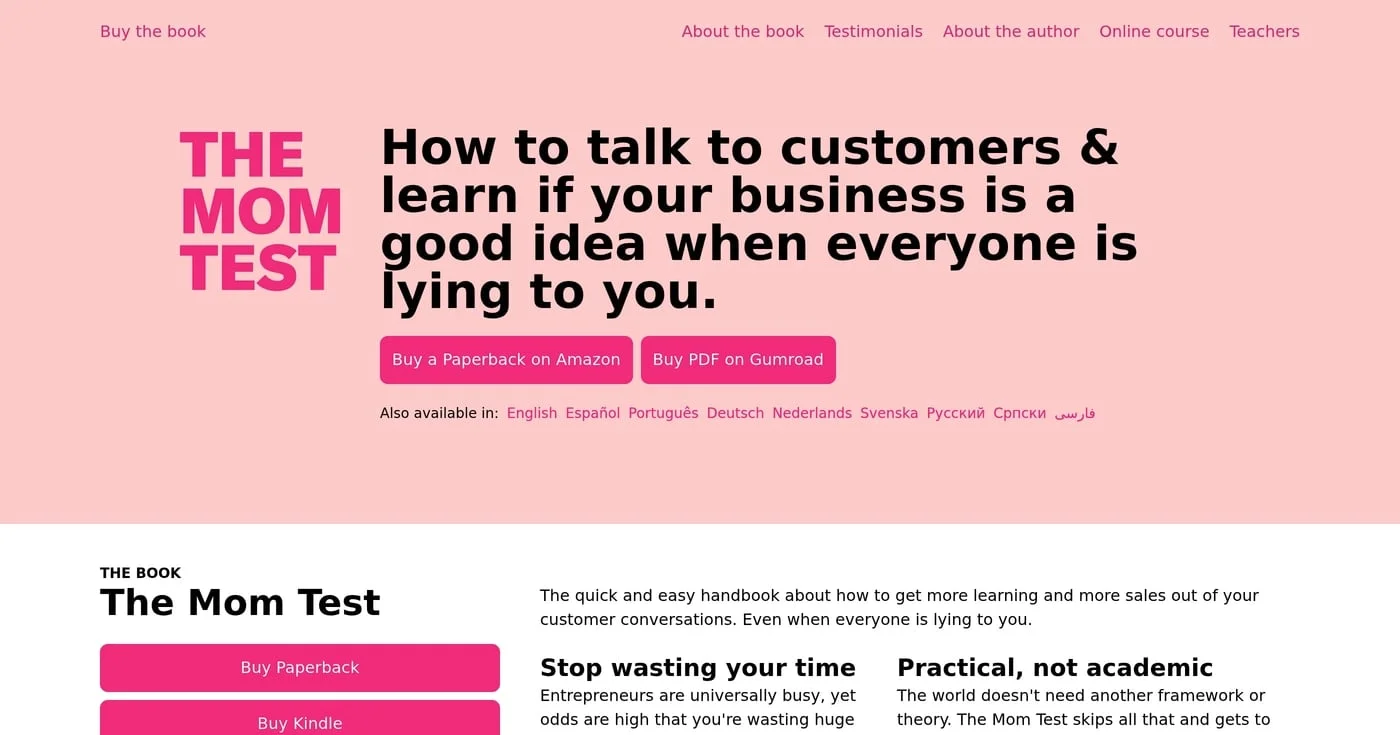
The subtitle is the thesis: How to talk to customers & learn if your business is a good idea when everyone is lying to you. Fitzpatrick's pitch on momtestbook.com is more learning and more sales from the same conversations.
The jacket copy, also on Harvard Book Store:
They say you shouldn't ask your mom whether your business is a good idea, because she loves you and will lie to you. This is technically true, but it misses the point. You shouldn't ask anyone if your business is a good idea. It's a bad question and everyone will lie to you at least a little. As a matter of fact, it's not their responsibility to tell you the truth. It's your responsibility to find it and it's worth doing right.
First edition: self-published, CreateSpace / Robfitz Ltd, ISBN 978-1-4921-8074-6. Harvard lists 10 Sep 2013 and 138 pages; Google Books lists 9 Oct 2013 and 136; Open Library catalogs 2014 and 135.
Do not pick a single page count. Treat 2014 as a catalog or revision line, not a different first edition.
A revised trade edition is in the works at Simon & Schuster (144 pages, $19.99, Authors Equity). It has not shipped. Read the book that exists.
Buy it from momtestbook.com (paperback plus PDF). Do not hunt a free file. The "PDF" searches are piracy.
The name is a gimmick. You phrase questions so even your mom could not lie, because you never asked her to rate your idea.
Fitzpatrick said it on camera at Startup Istanbul (18:02): you ask for facts about their life. "Instead of saying here's my idea, what do you think, you say hey, how did you deal with this last time."
The mom bit is a stereotype. Drop it after one clause. The useful half is the question design.
This book is for founders who already talk to customers and still walk out with fake traction. People still choosing online business ideas can read it before they write code. People hunting product-market fit use it to stop counting "that sounds amazing, launch it and I'll buy" as a yes.
If you wanted scripts, sample sizes, and a research repository, you wanted qualitative research, not this book.
The book's three rules are the whole method. Fitzpatrick's teacher notes map them to chapter 1.
A fourth line sits next to them: they own the problem, you own the solution. You do not get to tell them what hurts. They do not get to tell you what to build.
The moment you describe the product, the other person starts helping. Helping looks like approval.
Approval feels like product-market fit. It is usually manners.
Keep the idea in your pocket until you have the story of their last incident. If you need a classification question first ("are you even in this segment?"), ask that. Then shut up about what you are building.
Jason Cohen (@asmartbear) restated the same trap in December 2024: "Would you use this feature?" teaches you nothing, even when they say yes.
Don’t ask customers: “Would you use this feature?” Even if they say “yes,” they often won’t, and you didn’t learn anything else. Instead say: “Walk me through your workflow, in which you would use this feature.” They’ll often get tripped up; then you’ve learned.
Generics ("I always", "I never") and futures ("I would pay", "I will switch") are cheap to say. A dated story is expensive to fake.
"Walk me through the last time that happened" beats "how often do you face this?" "What did you try, and what did that cost?" beats "how much would you pay?"
If they have never looked for a fix, they are not going to look for yours. That line is the book's kill-shot on "interested" people who have spent $0 and zero hours on the problem.
Collect quotes, names, and emotions you can replay to the team the same day.
If you filled more than a third of the airtime, you interviewed yourself. Fitzpatrick's order on X in November 2022: learn first, pitch second. Once the pitch begins, deep learning ends.
"Mom test questions" is a search UX and meeting tools now try to own. The book is a swap: polite hypotheticals out, last-incident facts in.
Fail (they can fake this) | Pass (even your mom can't) |
|---|---|
Do you think it's a good idea? | Why do you bother? What's the hardest part of X? |
Would you buy a product that did X? | How are you solving this today? Have you ever paid? |
How much would you pay for X? | What does this problem cost you now (money, time, tools)? |
Would you use this if it existed? | Talk me through the last time that happened. What did you do? |
How often do you face this? | When did it last happen? Walk me through it. |
What would your dream product do? | What else have you tried? Show me the effort already spent. |
Add a few probes that keep the conversation in their world: "What are the implications of that?" "Talk me through your workflow." "Where does the money come from?"
Close with "Who else should I talk to?" and "Is there anything else I should have asked?"
Every conversation needs one question that could destroy the currently imagined business. If none of your learning goals can kill the idea, you are running a pep talk.
On r/Entrepreneur, u/edkang99 (February 2026) named the fail pair founders still use: "do you have this problem?" plus "would you want the solution?"
The replacements in that thread match the book: what have people tried, and why hasn't it worked.
A June 2026 r/indiehackers thread is the same loop in the wild: months of interviews, everyone loved the idea, nobody bought. The diagnosis was the questions, not the market.
Chapter 2 of the teacher map covers compliments, fluff, and wishlists. Three shapes of fluff show up in almost every transcript:
Compliments sit next to them. Fitzpatrick calls them shiny and worthless. Deflect and go back to the last incident.
At Digital Product School (21:24) he put it in founder English:
Someone's saying something nice about your idea is not progress. It's a compliment, it means nothing. It's like the fake phone number of business feedback.
The burger line in the same talk (22:42): you would not survey a restaurant to learn cheeseburger vs hamburger. You watch what they buy.
"Customers' behavior never lies. Their words do."
Feature requests are a third trap. "Can it also do X?" is not a spec.
Dig for the motivation: what broke last Tuesday that made them want X? Sometimes the answer is a weekly PDF, not a dashboard.
Do not file a stack of "love the idea" notes as validation. Strategyzer said the same thing without naming the book in August 2026: there is a gap between "I'd definitely buy this" and a card coming out. Strong evidence lives on the do side.
On r/startups (April 2026), u/mshadmanrahman described the dollar version of the politeness trap: two or three friendly chats, ship, flat adoption. The turning point was structured interviews that were not a sales call and not a wishlist session.
Most recap pages stop at the three rules. Chapter 5 is the part that makes the book a sales book as well as a learning book.
There is no such thing as a meeting that just "went well." Every meeting succeeds or fails.
Success is commitment (they give up something they value) plus advancement (the next real step in your funnel). Failure is a compliment or a stall ("let's circle back"). Not asking is how you fail the ask.
Currency | What they give up | What you can believe |
|---|---|---|
Time | A next meeting with goals, a wireframe review, a non-trivial trial | They will spend attention again |
Reputation | Intro to a peer, boss, spouse, or lawyer; a public testimonial | They will put their name on it |
Money | Letter of intent, pre-order, deposit | They will spend |
The more they give up, the more you can trust what they said. A spreadsheet they fill, an intro to the person who owns the budget, a prototype session, or a preorder is harder to fake than "this is so needed."
Match the ask to the stage. In a first coffee you are still in discovery, so you do not demand a wire transfer.
In a meeting that already went specific, you do ask. You held the pitch while you learned.
Strategyzer's September 2026 viability ladder is the cold water on this chapter: willingness-to-pay interviews sit at the bottom. Pre-sales, crowdfunding, pilots, and signed contracts sit at the top.
Good questions still produce weak evidence until money or a commitment moves. The book agrees. It still will not let you skip the conversation for a spreadsheet of untested numbers.
This is also why The Mom Test vs Million Dollar Weekend is a false religion fight. On r/Entrepreneur (February 2026), u/cryptoviksant split them as stages: the first book strips false positives, the second makes you ask for money.
You need both. Endless "validation" with no ask is procrastination in a strategy costume.
If nobody will take the meeting, you cannot run the method.
On a December 2025 r/indiehackers thread, a solopreneur with no warm network put the ratio at one call per 200-300 cold DMs. Stop blasting strangers. Join places people are already venting about the problem.
Do not write 50 questions. Fitzpatrick's January 2023 version: 3-4 crucial learning goals, so you can still improvise when someone hits a strong emotion or an intuition-breaking remark.
At least one goal should be able to kill the idea. Write the commitment you want if the meeting goes well. Look up public facts first, so you do not waste their time on them.
If it feels like they are doing you a favor, it is too formal. Coffee beats a recorded "user interview." You are not running ResearchOps.
Two people when you can: one leads, one notes. Capture exact quotes, emotions, and names. Classification first, then the problem, then (if you are in a later-stage meeting) the ask.
Seedcamp's Catch note from September 2026 is the enterprise version of "talk about their life."
The founders spoke to more than 100 executive assistants who do the job, not executives answering "would you use an AI agent?"
Replay the notes with the team the day you had the conversation. The anti-pattern is one "businessperson" as the learning bottleneck while engineers wait for a filtered summary.
Customer slicing belongs here too. Startups don't starve, they drown. Serve someone before everyone.
A vague "SMBs who invoice" is not a slice. A named workflow with a last-incident story is.
The 2013 book claimed remote customer development never works. Fitzpatrick reversed that in August 2022: video calls are now culturally serious. Summaries that still treat in-person as mandatory are quoting a retracted line.
In Mom Test (2013), I claimed that remote custdev never works. But these days it works _so well_, thanks to a broader cultural shift toward treating vid calls more seriously. Quick five-part explanation (can skip the first vid if already read the book): https://t.co/c7UhvweHnS
Eric Ries and Steve Blank already won the argument that you should get out of the building. Build-Measure-Learn is the loop. The missing handbook is what you say in the building you just walked into.
Job | Lean Startup / Blank | The Mom Test |
|---|---|---|
Core move | Get out of the building; run the loop | Talk without collecting lies |
Unit of progress | Validated learning via MVP and experiment | Facts about their life, then a commitment |
Failure mode | Building the wrong thing in silence | Polite yeses that never become revenue |
Proof | Experiment | Money, time, or reputation given up |
Giff Constable (2018) drew the same line next door: interviews give you the greatest insights; experiments give you the greatest proof. Do not trust "how much would you pay?" Sell.
This page does not replace Talking to Humans (Constable and Frank Rimalovski, 2014, Steve Blank foreword), which is how you structure, find, and run interviews. Testing with Humans (2018) is the experiment sequel. The Mom Test is the truth filter inside the conversation.
A January 2023 Indie Hackers post argued "The Mom Test is wrong" after the author asked would-you-buy and treated non-purchase as proof the book failed. That is the banned question. People who "tried The Mom Test" and still asked hypotheticals did not try the book.
Lenny Rachitsky (July 2022) found that only one of 50 consumer companies originated from customer conversations. That is a dunk on using talks to invent the idea.
Fitzpatrick is not a brainstorming method. He is a lie detector for demand you already think exists.
If you need the interview-ops layer (discussion guides, bias, sample, repository), use UX Crush: UX research methods and qualitative research. This page stays in the survival-reading cluster, next to product-market fit and Running Lean.
That question is the thing the book bans. Non-purchase after a hypothetical yes is the book working, not the book failing.
"So innovative, let me know when it launches" is a stall. Fitzpatrick's fake-phone-number line is the correction. Ask for time, an intro, or money.
Discovery without an ask leaves you with a folder of quotes. Chapter 5 says the meeting failed if nothing moved. Write the desired commitment before you sit down.
Recorded hour-long sessions, 50-question guides, and a "interviewed a hundred people because Rob said so" cargo cult miss his actual bar: a few people, stop when you keep hearing the same thing. Casual small-n is stronger on truth and weaker on board theater. Know which game you are in.
Strategyzer ranks willingness-to-pay interviews at the bottom of the viability ladder for a reason. A signed pre-sale beats a perfect transcript.
Start with the official handbook and the teacher chapter map (chapter 1 for the rules, chapter 2 for bad data, chapter 5 for the ask). Fitzpatrick is at robfitz.com and @robfitz.
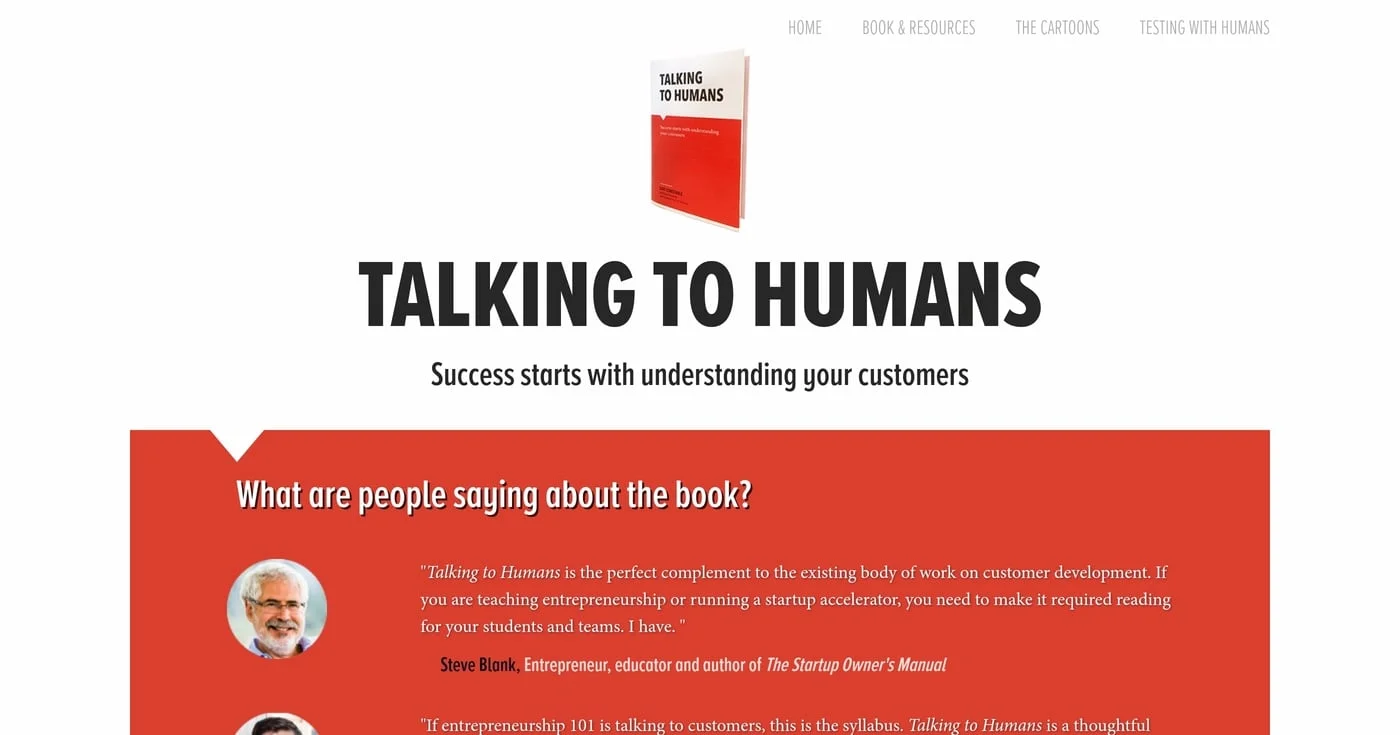
Pair it with Talking to Humans for interview structure, and with The Lean Startup plus Running Lean for the loop the conversations sit inside. Nail It Then Scale sits on the same shelf: nail the problem before you scale.
Later titles on this cluster, not summaries on this page: Traction (book), Blitzscaling, High Growth Handbook. Adjacent: Zero to One, Crossing the Chasm, The Hard Thing About Hard Things, Cindy Alvarez's Lean Customer Development.
Fitzpatrick has also pointed people at Never Split the Difference, This is Marketing, and SPIN Selling. One r/startups comment would swap The Mom Test for Deploy Empathy. Read both if you want; do not treat the swap as a refutation.
Reception, not a reason to buy: the official handbook says it is taught at Harvard and UCL, and used at Seedcamp, Microsoft Ventures, and Shopify. The teacher notes add London Business School.
Simon & Schuster also names MIT and Skyscanner. Simon Murdoch, on the official site, called it the best and most accessible book for entrepreneurs seeking product-market fit.
Copy counts are author-marketing and bounce between editions. Skip them.

Delaware C-corp if you will raise, grant options, or want QSBS. LLC if you stay closely held and distribute profits. Covers tax, investors, conversion.

A vesting schedule is how startup equity becomes yours. Get 4-year/1-year-cliff math, founder reverse vesting vs options, and double-trigger acceleration.

Bootstrapping a business funds growth from revenue, not a priced round. Split savings from customer cash, then use the cage test for when to raise.
