Best Equity Management Software: Top 10 Picks for 2026

Compare the 10 best equity management software platforms in 2026. Includes free plans, pricing, 409A support, and cap table tools for startups at every stage.

May 8, 202616 min read
Best equity management software platforms overview

The best equity management software in 2026: Carta (trusted by 50,000+ companies), Eqvista (ranked #1 on G2, free for up to 20 stakeholders), and Pulley (transparent pricing from $100/mo, 409A in 2-3 days). Your best pick depends on stage, geography, and how much compliance you need today.

The equity management software market is valued at $1.65 billion in 2026 and is projected to reach $4.55 billion by 2035. The growth is driven by startups using stock-based compensation to attract talent without burning cash.

In this guide, you'll explore the top 10 equity management software platforms available in 2026.

Key Takeaways

  1. Free plans are widely available: Ledgy, Carta, Eqvista, Cake Equity, and Qapita all offer free tiers. Ledgy's is the most generous at up to 50 stakeholders.
  2. Pricing transparency varies widely: Pulley and Cake Equity publish pricing openly; Carta, J.P. Morgan Workplace Solutions, Certent, and Shareworks require sales calls.
  3. Geographic specialization matters: Vestd is built for UK share schemes, Qapita leads in APAC, and Ledgy dominates European compliance.

Top 10 Picks for Best Equity Management Software

  1. Carta - Best for companies scaling from seed to IPO
  2. Pulley - Best for founders who want transparent pricing
  3. Eqvista - Best free cap table with lowest-cost 409A bundles
  4. Ledgy - Best for European startups and multi-jurisdiction compliance
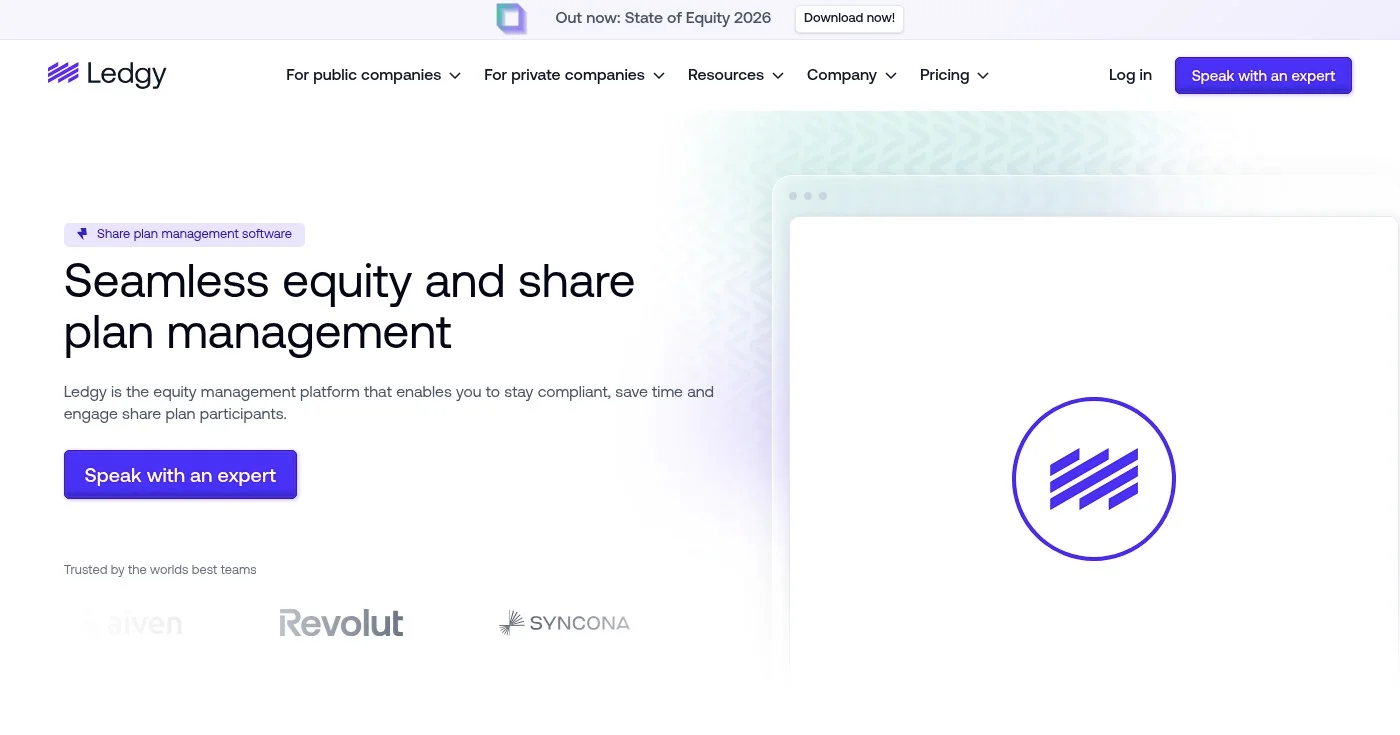
  5. Cake Equity - Best for ease of use across international teams
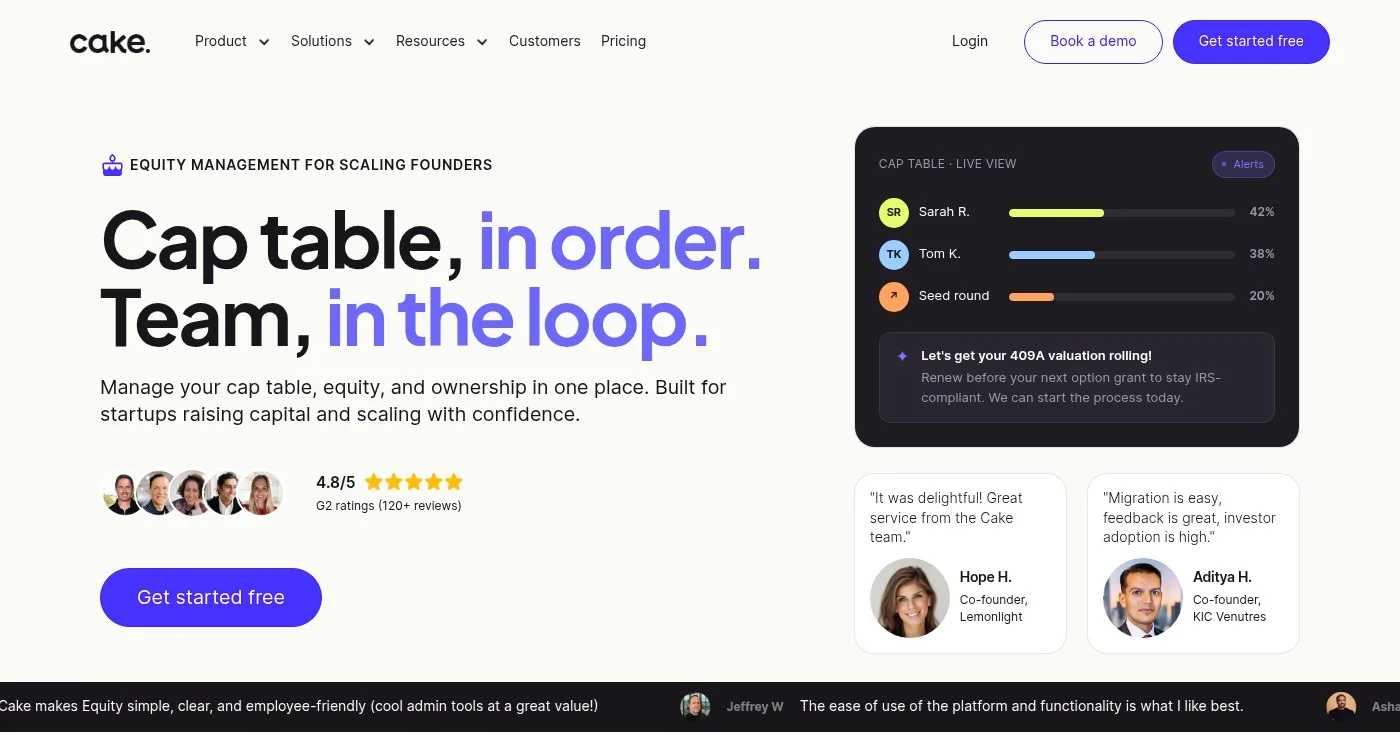
  6. Qapita - Best for APAC startups and fund administration
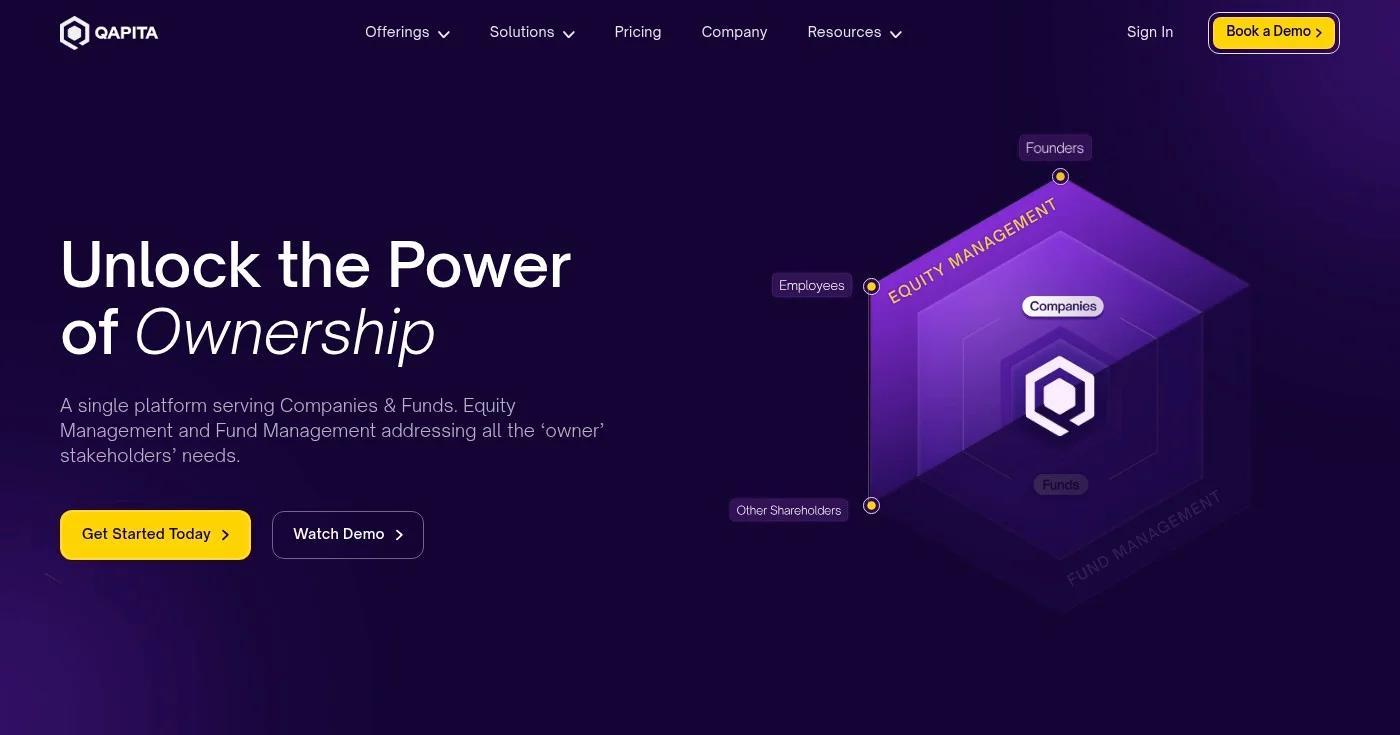
  7. J.P. Morgan Workplace Solutions - Best for enterprise global equity management
  8. Vestd - Best for UK-based SMEs and share schemes
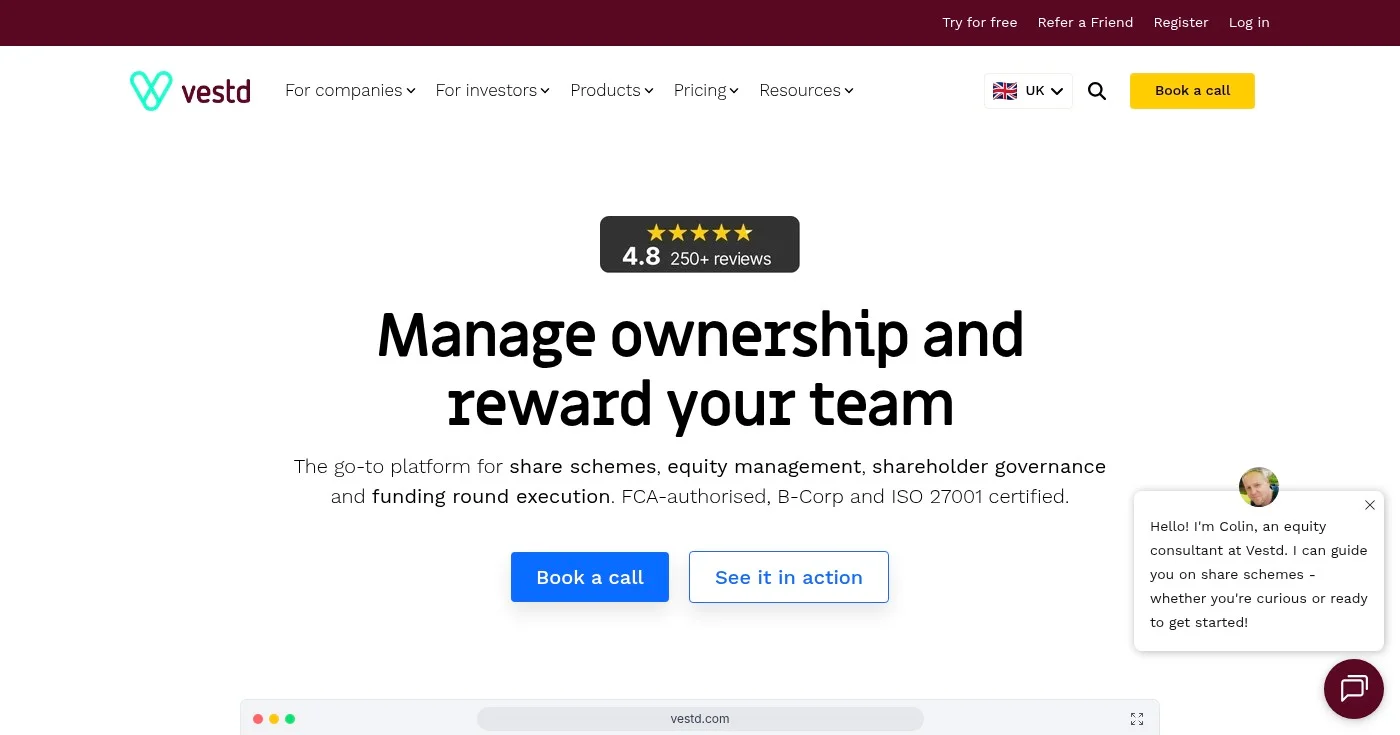
  9. Certent Equity Management - Best for enterprise financial reporting integration
  10. Morgan Stanley Shareworks - Best for public and late-stage private companies
How to Evaluate Equity Management Software

  • Cap table accuracy: Clean, real-time records prevent stalled fundraising rounds during due diligence.
  • ESOP and stock plan management: You need tools to issue, vest, and exercise options for employees across jurisdictions.
  • 409A valuation support: Required for pricing employee stock options; look for in-house or integrated valuation services.
  • Compliance features: Check for 83(b) election support, Form 3921, Rule 701, ASC 718, and any jurisdiction-specific filings relevant to your team.

Comparison Table

Software

Best For

Key Features

Pricing

Free Plan

Platforms

Carta

Seed to IPO

Cap table, 409A, SAFE modeling, scenario modeling

From free (Launch)

Yes

Web, iOS, Android

Pulley

Transparent pricing

Cap table, 409A (2-3 days), SAFE, token equity

$100/mo (billed yearly)

No

Web

Eqvista

Low-cost 409A

Cap table, ESOP, 409A, ASC 718, QSBS

Free; from $83/mo 409A bundle

Yes

Web

Ledgy

European compliance

70+ HRIS integrations, multi-entity, HMRC/IFRS

Free (Launch); from ~$270/mo (Scale)

Yes

Web

Cake Equity

Ease of use

Cap table, SAFE, stock options, 409A add-on

Free (5 stakeholders); $40/mo Starter

Yes

Web

Qapita

APAC markets

Cap table, ESOP, 409A, fund admin, data room

Free (Spark); $133/mo Surge

Yes

Web

J.P. Morgan WS

Enterprise global

Cap table, stock plans, ASC 718, IFRS 2

Custom

No

Web

Vestd

UK share schemes

EMI, CSOP, HMRC filings, Companies House

From £133/mo

No

Web

Certent EM

Enterprise reporting

Equity admin, disclosure management, budgeting

Custom

No

Web

Morgan Stanley Shareworks

Public companies

Equity awards, ESPP, wealth management

Custom

No

Web

1. Carta

Best for companies scaling from seed to IPO

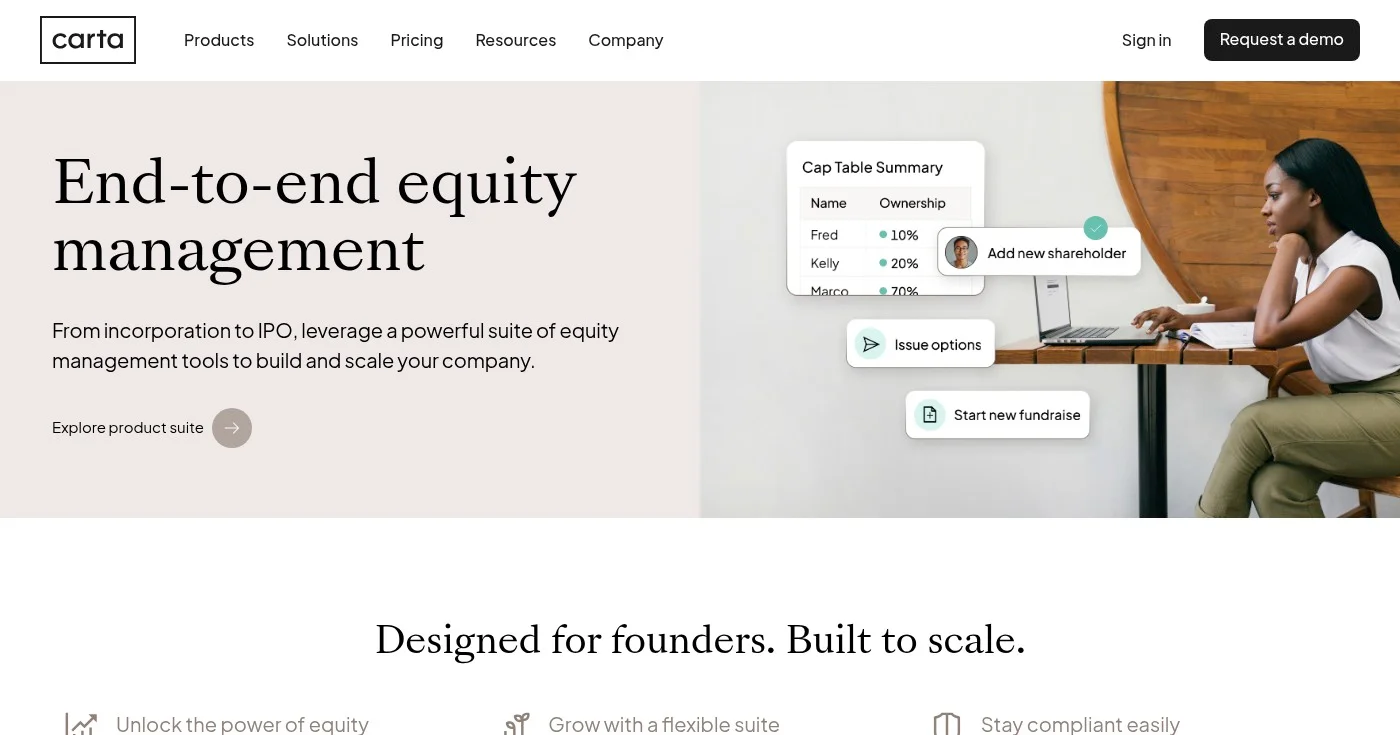
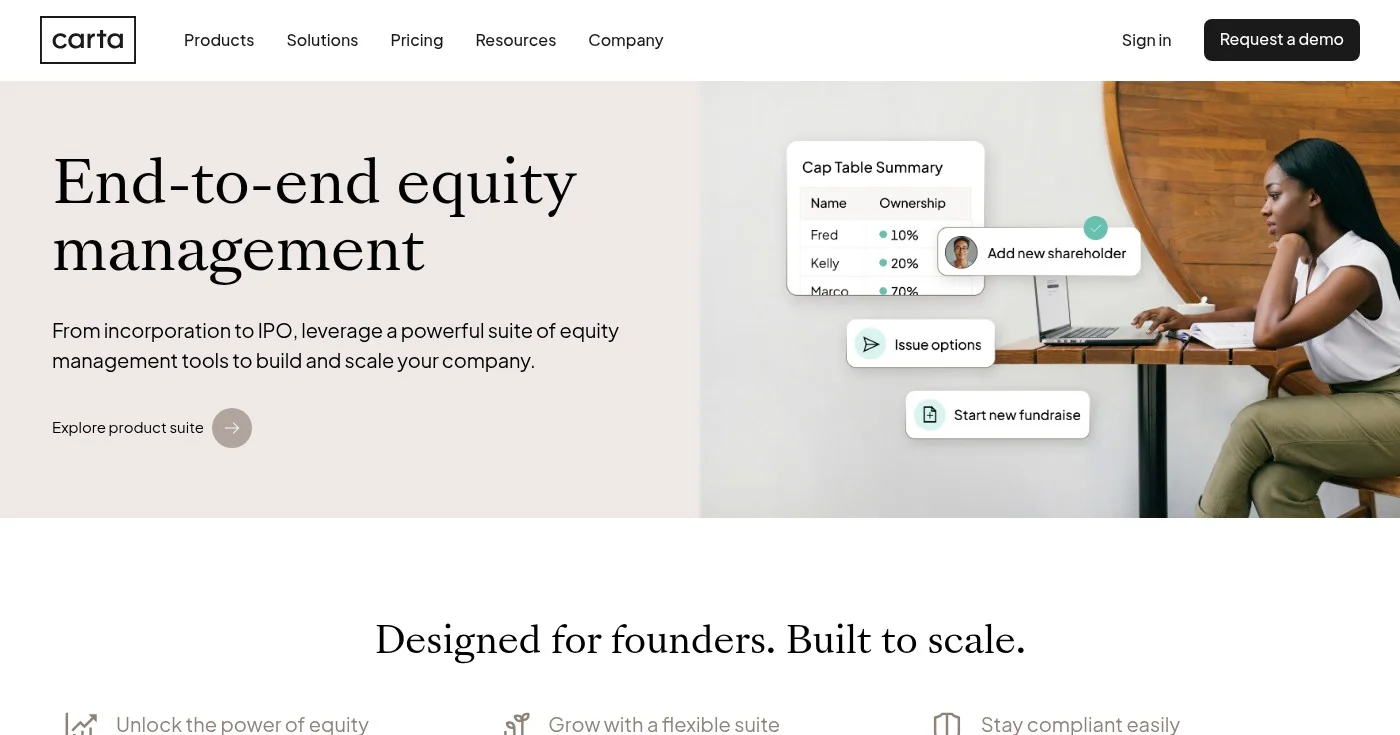
Carta equity management platform homepage

Carta is the most widely adopted equity management platform, trusted by 50,000+ private companies and managing over $4.2 trillion in total equity value. It covers the full equity lifecycle: cap table setup, SAFE issuance, equity plan administration, 409A valuations, and fund management: all in one platform.

For early-stage companies, Carta's free Launch plan supports up to 25 stakeholders and includes SAFE modeling, ISO management, and HRIS integration. As you grow, paid plans add scenario modeling, board meetings, Form 3921 generation, Rule 701 compliance, and 409A valuation audit support. Carta also recently launched Total Comp, a compensation management platform with benchmarks and leveling tools.

Pros

  1. Most comprehensive ecosystem: cap table, fund management, LP reporting, and now compensation
  2. Trusted by more companies than any competing platform
  3. Free Launch plan is genuinely useful for pre-seed and seed companies

Cons

  1. Pricing not publicly listed for Build, Grow, or Scale plans; requires a sales conversation
  2. Paid plans require a sales call for pricing; mid-stage companies typically pay several thousand dollars per year
  3. Can feel oversized for founders who only need basic cap table management

Pricing

  • Launch: Free (up to 25 stakeholders, $1M raised)
  • Build: Contact for pricing (up to 50 stakeholders)
  • Grow: Contact for pricing (flexible stakeholders; 409A valuations, Form 3921, board meetings; median ~$379/mo billed yearly)
  • Scale: Contact for pricing (Rule 701, audit support)

All paid plans require contacting Carta directly. See Carta pricing for details.

2. Pulley

Best for founders who want transparent pricing

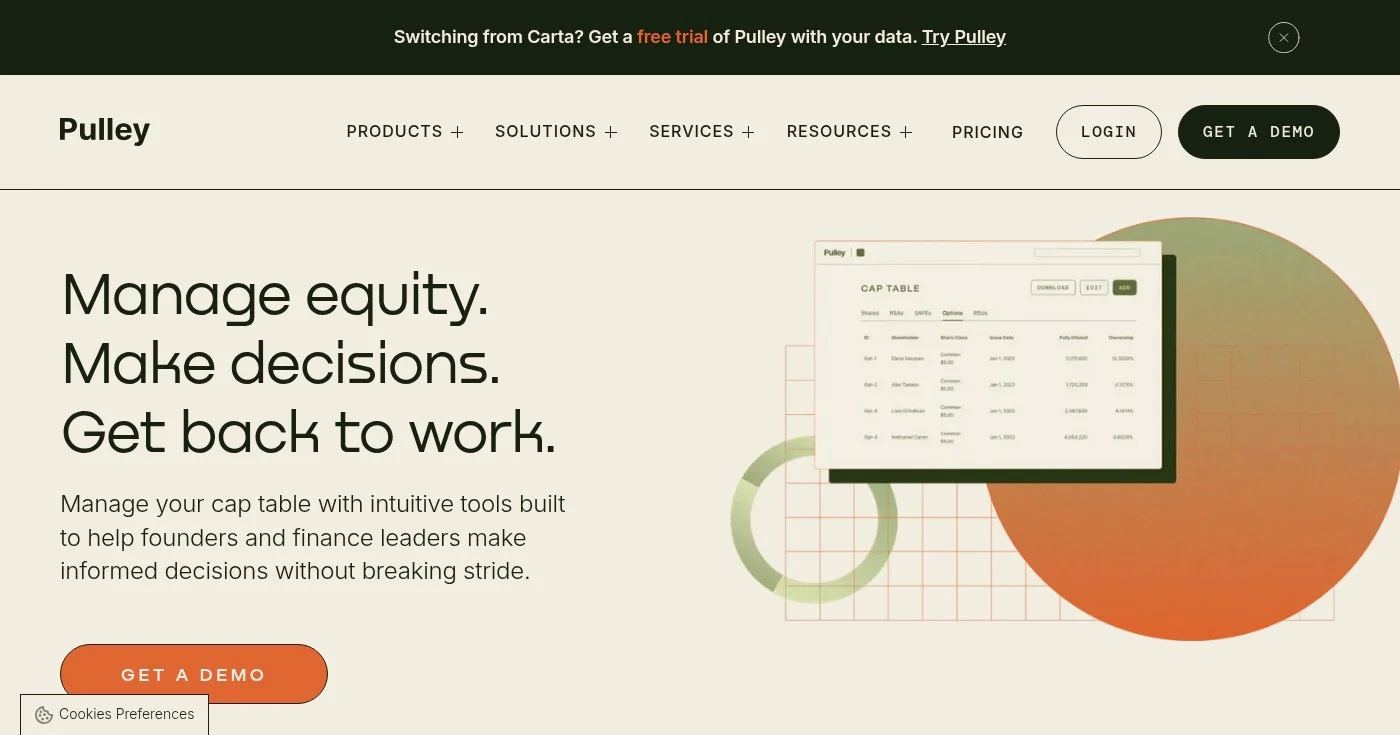
Pulley cap table software homepage

Pulley is built specifically for founders and finance leaders who want clear pricing, fast turnarounds, and a clean interface. Unlike Carta, Pulley publishes all pricing publicly with no hidden fees. Its 409A valuations are delivered in 2-3 days (compared to weeks with some competitors), and it supports token/crypto equity for blockchain-native startups.

Pulley's data ownership policy stands out: your cap table data is yours and is never monetized. The platform also supports HRIS integrations with Gusto, QuickBooks, Workday, and BambooHR on its Growth plan, keeping equity data synced with payroll automatically.

Pros

  1. Fully transparent pricing published on the website, no sales call required
  2. In-house 409A valuations delivered in 2-3 days, not weeks
  3. Token and crypto equity support built in from day one

Cons

  1. No free plan; smallest tier starts at $100/mo (billed yearly)
  2. Smaller ecosystem and investor network compared to Carta
  3. API access not available as a standard feature

Pricing

  • Startup: $1,200/year ($100/mo billed yearly; 25 stakeholders; cap table, SAFE, fundraise modeler, e-signing)
  • Growth: $3,500/year (~$292/mo billed yearly; 40 stakeholders; adds 409A, option exercises, Form 3921, HRIS integrations)
  • Enterprise: Custom (ASC 718, managed equity administration, secondary liquidity)

See Pulley pricing for the current rate card.

3. Eqvista

Best free cap table with lowest-cost 409A bundles

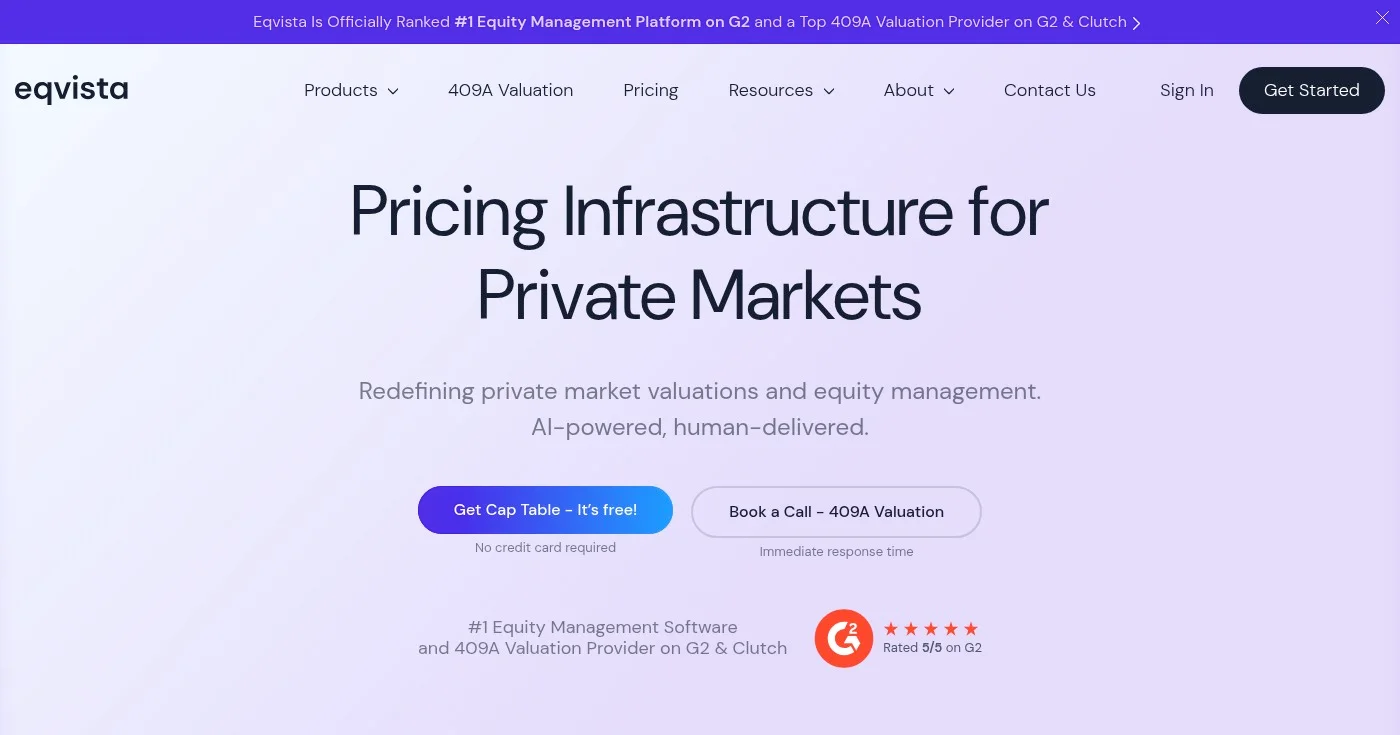
Eqvista equity management platform homepage

Eqvista is rated #1 in equity management on G2 and trusted by 23,000+ companies from early-stage to pre-IPO. Its pricing can run up to 70% lower than comparable platforms, making it the go-to for cost-conscious founders. The Freemium plan supports up to 20 stakeholders at no cost.

Eqvista also offers AI-powered Real-Time Valuation® for continuous stock price visibility, QSBS attestation, and 83(b) election mail-in to the IRS on its Enterprise plan. For startups that need a defensible 409A quickly without paying Carta-scale prices, Eqvista's 409A + Premium Cap Table bundle starting at $990/year is the most competitive option in the market.

Pros

  1. Ranked #1 on G2 for equity management, backed by 23,000+ companies
  2. Most affordable 409A valuations: from $990/year (Startup) vs. $4,500+ at Pulley
  3. Freemium cap table free forever for up to 20 stakeholders

Cons

  1. Interface less polished than Carta or Cake Equity
  2. Smaller network effect than Carta (fewer investor integrations)
  3. Custom pricing applies above 50 stakeholders on the Premium plan

Pricing

  • Freemium Cap Table: Free (up to 20 stakeholders; cap table, ESOP, vesting, data room)
  • Premium Cap Table: $2/stakeholder/month (e-signing, board resolutions, Rule 701, Form 3921, exit modeling)
  • 409A + Premium Bundle: From $990/year (Startup); $1,290/year (Funded); $1,990/year (Seed); $2,590/year (Series A); custom for Series B+
  • Enterprise: From $1,990/year (adds QSBS, ASC 718, Real-Time Valuation®)

See Eqvista pricing for details on each tier.

4. Ledgy

Best for European startups and multi-jurisdiction compliance

Ledgy equity management platform homepage

Ledgy is a Swiss-based equity management platform built for high-growth companies that operate across multiple countries and jurisdictions. Its free Launch plan supports up to 50 stakeholders, the most generous free tier of any platform on this list. The paid Scale plan unlocks 70+ HRIS integrations including BambooHR, Personio, HiBob, Workday, Deel, and Humaans.

Ledgy covers US GAAP (ASC 718), IFRS 2, and UK GAAP for financial reporting, and supports HMRC, 409A, and BSPCE valuations for multi-country teams. UK Companies House reporting is built in. For European founders managing equity across borders, Ledgy's multi-entity cap table and automated onboarding/offboarding workflows reduce hours of manual admin.

Pros

  1. Most generous free plan: supports up to 50 stakeholders at no cost
  2. 70+ HRIS integrations (the deepest in the market)
  3. Multi-jurisdiction compliance covers HMRC, BSPCE, ASC 718, and IFRS 2 in one platform

Cons

  1. Scale plan priced in euros (from €3,000/year), adding currency risk for non-euro companies
  2. Less US market presence compared to Carta or Pulley
  3. Financial reporting is an add-on to the Scale plan, not included by default

Pricing

  • Launch: Free (up to 50 stakeholders; cap table, equity plans, stakeholder dashboards)
  • Scale: From €3,000/year (~$270/mo; adds HRIS integrations, offboarding workflows, compliance reports, valuations)
  • Enterprise: Custom (SSO, advanced security, dedicated support)

See Ledgy pricing for a full feature breakdown.

5. Cake Equity

Best for ease of use across international teams

Cake Equity cap table software homepage

Cake Equity is ranked #1 on G2 for ease of use and customer satisfaction and trusted by 20,000+ fast-growing companies. Its clean interface and guided onboarding make it the fastest platform to get started on, even for founders with no prior equity management experience. It supports US, UK, Australia, New Zealand, Singapore, and 15+ other countries.

The employee portal (MyCake) gives team members real-time visibility into their equity, vesting schedules, and grant documents. For startups running option programs across multiple geographies, Cake's international option pools and ASC 718 / share-based payment reporting on the Pro plan cover the complexity without the Carta price tag. A 409A valuation is available as a $1,000 add-on to any plan.

Pros

  1. Highest ease-of-use rating on G2 among all equity management tools
  2. International support: US, UK, Australia, Singapore, and 15+ additional countries
  3. MyCake employee portal provides transparent equity visibility for your team

Cons

  1. Free plan limited to 5 stakeholders; less useful for most startups than competitors' free tiers
  2. Growth plan pricing requires contact; only Starter ($40/mo) is transparent
  3. Less feature depth than Carta for complex multi-round structures

Pricing

  • Free: $0 (5 stakeholders; cap table, stock options, SAFE notes)
  • Starter: $40/mo (30 stakeholders + $1/additional; cap table, vesting, SAFE, fundraising modeling, e-signing)
  • Growth: Contact for pricing (30 stakeholders + $5/additional; adds stock options, RSUs, RSAs, warrants)
  • Pro: Custom (409A, ASC 718, 3921 reporting, international option pools, managed migration)
  • 409A add-on: $1,000 (available on any plan)

See Cake Equity pricing for country-specific rates.

6. Qapita

Best for APAC startups and fund administration

Qapita equity management platform homepage

Qapita is Singapore-based and serves 2,200+ companies across India, Southeast Asia, and globally. It's the strongest platform for APAC regulatory compliance, with ESOP administration built specifically for Indian and Southeast Asian legal frameworks. Qapita also extends beyond cap table management into fund administration, ESOP trust formation, and IPO preparation.

The platform is ISO 27001 and SOC 2 certified and GDPR compliant, making it suitable for companies with data privacy obligations. The free Spark plan supports up to 25 stakeholders with full cap table management, equity plan administration, DocuSign integration, and a data room. This is competitive with Carta's free Launch plan.

Pros

  1. Strongest APAC compliance coverage: Indian ESOP regulations, APAC securities law
  2. ISO 27001 and SOC 2 certified with GDPR compliance for data-sensitive companies
  3. Free Spark plan supports 25 stakeholders with DocuSign and a data room included

Cons

  1. ESOP administration is strongest for India and Southeast Asia; less US-focused
  2. Smaller ecosystem and integrations compared to Carta or Ledgy
  3. Growth plan adds $60/stakeholder/year above 50 stakeholders, which can scale quickly

Pricing

  • Spark: Free (up to 25 stakeholders; cap table, equity plan, DocuSign, data room)
  • Surge: $1,600/year (~$133/mo; up to 40 stakeholders; +$40/stakeholder/year)
  • Growth: $3,000/year (~$250/mo; up to 50 stakeholders; +$60/stakeholder/year; adds 409A, board consents, 83b)
  • Enterprise: Custom (ASC 718, IFRS, dedicated CSM, SSO, HRIS integration)

See Qapita pricing for regional pricing options.

7. J.P. Morgan Workplace Solutions

Best for enterprise global equity management

Formerly Global Shares and now part of JPMorgan, Workplace Solutions is an enterprise-grade equity management platform trusted by businesses worldwide. It combines institutional financial expertise with modern cap table and stock plan management, connecting automatically to payroll, tax, and HR systems via API. For companies with complex global equity structures, the institutional backing adds credibility during due diligence and audit processes.

The platform covers the full employee equity lifecycle: stock options, RSUs, RSAs, performance shares, and SAFEs. Automated ASC 718, IFRS 2, EPS, deferred tax, and disclosure filings reduce manual compliance work. Role-based access and full audit trails make it suitable for companies approaching IPO or with public company reporting requirements.

Pros

  1. Institutional J.P. Morgan backing provides added credibility for enterprise and pre-IPO companies
  2. Automated ASC 718, IFRS 2, and EPS filings reduce compliance overhead significantly
  3. Deep payroll and HR integrations via API sync equity data automatically

Cons

  1. Custom pricing only; no public rate card available
  2. Sales and demo process required before accessing the platform
  3. Feature depth may be excessive for early-stage or simple cap tables

Pricing

  • All plans: Custom (contact J.P. Morgan Workplace Solutions sales team)

See J.P. Morgan Workplace Solutions for more details.

8. Vestd

Best for UK-based SMEs and share schemes

Vestd share scheme and equity management platform

Vestd is the leading UK-focused equity management platform, FCA regulated and B Corp certified. It specializes in UK-specific share schemes including EMI (Enterprise Management Incentives), CSOP, Growth Shares, and Unapproved Options. All are handled within the platform with live HMRC submission support and full Companies House integration.

EMI is the most tax-efficient share scheme for UK employees, and Vestd is purpose-built for it. The platform automates EMI1 and EMI40 filings, generates share certificates, and connects directly to HMRC for real-time submissions. For UK founders managing a team on share options, Vestd eliminates the legal admin that typically requires an employment lawyer.

Pros

  1. FCA regulated and ISO 27001 certified; strongest compliance credentials for UK companies
  2. EMI, CSOP, and Growth Share schemes handled natively with automated HMRC filings
  3. Full Companies House integration automates director and share register updates

Cons

  1. UK-only focus: not the right tool for US C-corps or multi-country equity outside the UK
  2. No free plan; minimum commitment is 12 months
  3. Pricing in GBP adds complexity for international companies

Pricing

  • Self-Serve: From £1,600/year (~£133/mo; up to 5 scheme recipients; EMI, Growth Shares, Unapproved Options)
  • Guided: From £4,200/year (~£350/mo; all share schemes, unlimited valuations, CSOP, phantom shares, live HMRC support)
  • Full Service: Custom (hands-free management, dedicated account manager)

See Vestd pricing for a full plan comparison.

9. Certent Equity Management

Best for enterprise financial reporting integration

Certent Equity Management by insightsoftware

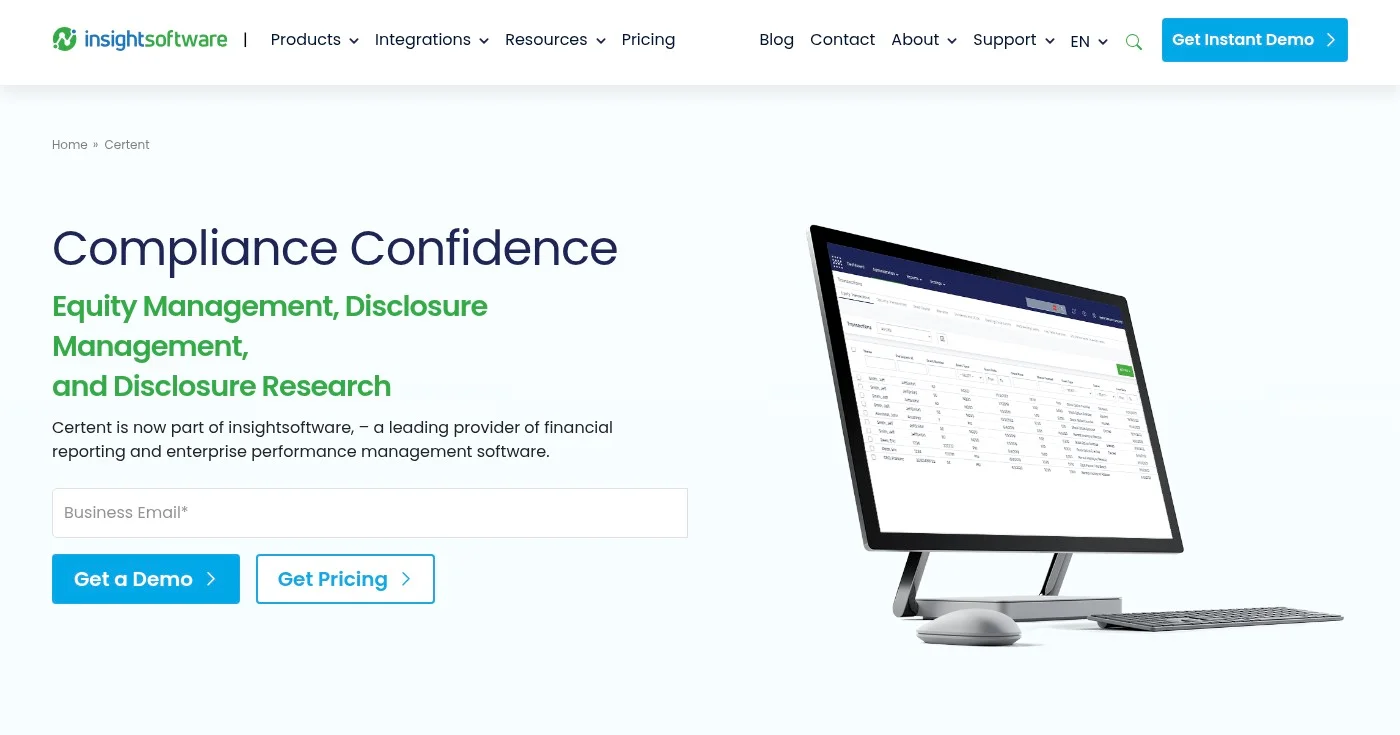
Certent Equity Management by insightsoftware extends beyond cap table management to cover disclosure management, financial reporting, and budgeting. That scope makes it the right fit for large enterprises that need equity compensation woven into their broader financial reporting stack. It is rated 4.6/5 on Capterra across 85 verified reviews.

Unlike startup-focused platforms, Certent EM is designed for companies already running on insightsoftware's OneStream or similar financial performance management tools. It handles stock plan administration, equity compensation expense reporting under ASC 718, and integrates with existing ERP and HR systems. For pre-IPO companies building audit-ready financial reporting, Certent reduces the gap between equity records and financial disclosures.

Pros

  1. Combines equity management with disclosure management and financial reporting in one suite
  2. Strong enterprise integrations with ERP and performance management tools
  3. Rated 4.6/5 on Capterra across 85 verified enterprise reviews

Cons

  1. Custom pricing only; not suitable for budget-constrained early-stage companies
  2. Designed for enterprises: onboarding and implementation takes significantly longer than startup tools
  3. Less visibility in the startup ecosystem; primarily sold to mid-market and enterprise

Pricing

  • All plans: Custom (contact insightsoftware sales)

See Certent Equity Management for enterprise pricing details.

10. Morgan Stanley Shareworks

Best for public and late-stage private companies

Morgan Stanley Shareworks equity compensation platform

Morgan Stanley Shareworks is a comprehensive equity compensation platform for managing cap tables, equity awards, and employee stock programs, backed by Morgan Stanley's financial services ecosystem. It gives employees access to Morgan Stanley financial advisors alongside their equity portal: a meaningful retention benefit for companies competing for senior talent.

Shareworks covers RSUs, stock options, performance shares, and employee stock purchase plans (ESPP). For companies approaching or completing an IPO, having Morgan Stanley's institutional name on the equity platform simplifies conversations with institutional investors and underwriters who already operate within the Morgan Stanley ecosystem.

Pros

  1. Morgan Stanley financial advisor access for employees adds real retention and compensation value
  2. Institutional credibility for public company stock plan administration
  3. Covers ESPP, RSUs, performance shares, and complex public equity structures

Cons

  1. Custom pricing with no transparency; sales-driven procurement process
  2. Built for public or late-stage companies; not suitable for seed or early-stage startups
  3. Switching costs are high once deeply integrated with Morgan Stanley brokerage accounts

Pricing

  • All plans: Custom (contact Morgan Stanley at Work for pricing)

See Morgan Stanley Shareworks for more information.

How to Choose the Right Equity Management Software

  • Stage: Pre-seed and seed founders should start with a free plan (Eqvista, Ledgy, Qapita, or Carta's Launch). Series A+ companies need 409A valuations, HRIS integrations, and compliance features.
  • Geography: US C-corps have the most options; UK companies should evaluate Vestd; APAC startups should look at Qapita; European companies with multi-country teams fit Ledgy best.
  • Budget: Eqvista is the most affordable with 409A bundles from $990/year; Pulley is transparent at $1,200/year; Carta's real cost often surprises founders at $4,500+ per year.
  • Complexity: Simple cap tables with a handful of stakeholders fit any free plan; companies with employee option pools, convertible notes, SAFEs, and multiple funding rounds need dedicated scenario modeling and compliance tools.
  • AI-powered valuations are shortening 409A turnaround times from weeks to days. Eqvista's Real-Time Valuation® uses AI to provide continuous stock price visibility between formal valuations.
  • Token and crypto equity management is a growing category: Pulley's dedicated token cap table ($4,500/year) supports crypto-native startups managing token vesting and unlock schedules alongside traditional equity.
  • HRIS integration depth is becoming a key differentiator. Ledgy leads the market with 70+ HRIS integrations, automating onboarding, offboarding, and grant workflows directly from HR systems.

Conclusion

The best equity management software for most early-stage startups is Eqvista (free plan, lowest-cost 409A, #1 on G2) or Pulley (transparent pricing, fast valuations, founder-friendly UX). Companies scaling toward Series B and beyond should evaluate Carta for its ecosystem depth, or Ledgy if you're operating across European jurisdictions. UK founders should start with Vestd.

For more data on the startup funding landscape, see venture capital statistics for 2026.

Frequently Asked Questions

Related Articles